Your body is not lazy. It's not broken. It's not a problem to solve in the next fifteen minutes. Delayed arousal. is completely normal. It happens to people with all kinds of bodies, at all life stages, and for wildly different reasons. Stress, medication, hormones, relationship dynamics, aging, fatigue, or simply how your nervous system is wired. None of it makes you wrong.
What it does mean is that the vibrator settings designed for someone whose arousal ramps up in five minutes might not be your best friends. You need a different approach. And honestly, that's where a lemon vibrator becomes genuinely useful, not because it's magic, but because the settings and sensations map onto slow buildup really well.
Let's start with physiology. Your brain is the actual control center here. When you're aroused, blood flow increases to the genitals, tissues become more sensitive, lubrication happens, and your nervous system shifts into parasympathetic mode (that's the relaxed, turned-on state). For some people, that whole chain reaction happens in minutes. For others, it takes twenty, thirty, sometimes forty-five minutes to fully complete.
This isn't a speed issue. It's a sensitivity threshold issue. Your nervous system might need more input, or gentler input held longer, before that cascade of signals reaches critical mass. Add in stress, medication side effects, relationship tension, or just the cumulative fatigue of modern life, and that threshold gets even higher.
Another piece: arousal isn't linear. It's not a dial that goes from 0 to 100. It climbs, plateaus, dips, climbs again. If you stop stimulation the moment it dips, you're starting over. If you keep going, understanding that the plateau is normal and not a sign of failure, arousal builds. A lemon vibrator's design actually supports this because you can maintain consistent sensation without your hand getting tired, and you can experiment with patterns that keep the stimulation interesting without being jarring.
Start at pattern one or two. Not because you need something weak, but because your body needs time to register the sensation and build anticipatory pleasure. Patterns one and two on a lemon vibrator usually sit around 40-50% intensity. Your nervous system can track a subtle sensation much more easily than it can process an intense one.
Stay in that zone for at least ten minutes. Seriously. I know that sounds long. It's not. You're letting your body adjust, nerves wake up, arousal slowly climb. If you jump to pattern five or six after two minutes because nothing "big" has happened, you're fighting against your own biology. You're also likely to miss the moment your body actually does start responding.
Once you've settled into the sensation and feel arousal building, that's when you can experiment. Some people do best staying on pattern one but adding a slight change in angle. Others prefer to move up to pattern three after about fifteen minutes and hold there. Some people love pattern two's rhythm so much they never leave it. The point is you get to find what tracks with your body's pace, not someone else's timeline.
If you find yourself consistently at twenty-five minutes with no orgasm happening, that's not failure. That's data. Some people's bodies are wired for orgasm through extended gentle stimulation, not fast intensity. That's a feature, not a bug. You get to have really extended, textured experiences that people who climax fast don't usually access.
Here's where I see most of the friction: your brain gets impatient before your body does. You think "this should be happening by now" and that thought immediately recruits your sympathetic nervous system, which is the fight-or-flight mode. It literally shuts down arousal. You've now sabotaged yourself with your own expectations.
A lemon vibrator helps here too, but only if you actually use it differently. Instead of aiming for orgasm, aim for pleasure. Instead of tracking time, set a container (maybe thirty minutes, maybe forty-five) and decide that within that container, your only job is to notice what feels good in that moment. Not what should feel good. What actually does.
Notice the warmth building. Notice how the rhythm changes your breathing. Notice whether you prefer staying on one pattern or moving between two. Notice the difference between your body and your environment. Are you rushed. Are you checking your phone. Are you worried about how you look. Those details matter more than the vibrator setting.
Time and privacy are non-negotiable. If you have forty minutes but half of them are spent listening for footsteps or keeping one ear on whether the kids are still asleep, you've already added a layer of tension. Give yourself real space.
Warmth helps too. A lot of people find that being warm, either under blankets or just in a heated room, makes arousal easier. Cold, tense muscles stay in that sympathetic fight-or-flight mode. Warm, relaxed muscles are more likely to respond to sensation.
Lubrication matters here more than you'd think. Even if your body eventually produces its own, starting with a water-based lube means you're not adding friction that demands proof of arousal. You're removing that barrier. It makes the sensation smoother, which lets your nervous system focus on pleasure instead of friction.
And honestly. Set your phone down. Not in another room where you're wondering about it, but actually set it somewhere you won't touch it. Notifications, the blue light, the awareness that you're reachable, all of that pulls arousal down.
The biggest one: switching settings too fast. You jump from pattern one to pattern three to pattern five in the first ten minutes because you're checking whether anything's happening. You're essentially interrupting your body's process repeatedly. It's like starting to fall asleep and then checking the time every thirty seconds. You never actually get there.
The second: assuming delayed arousal means low sensation threshold. Some people with delayed arousal actually want pretty intense sensation once their body is warmed up. They need gentleness early, then power later. A lemon vibrator's range from pattern one through six gives you that bandwidth.
The third: not communicating this to a partner. If you're using a lemon clitoral vibrator alone, this is straightforward. If you're with someone, tell them what you need. "I need about twenty minutes before I'm really aroused. I'm not doing anything wrong. My body just builds differently." This prevents your partner from interpreting slow arousal as lack of attraction or boredom. It's neither. It's how you're wired.
The fourth: shame. Delayed arousal can feel like everyone else's body works on a faster clock. The template is five-minute foreplay and quick pleasure. Your body is three times that. That doesn't make you broken. It makes you interesting. Your longer arousal window means more sustained pleasure, deeper sensation, and often more satisfying orgasms once they happen. You're not failing. You're different.
A lemon vibrator is genuinely useful here because of the suction sensation and the pattern range. That rhythmic stimulation without the constant buzzing intensity of a traditional vibrator can actually be easier for delayed arousal people to track and respond to. The clitoral suction design also tends to create broader, more distributed sensations that build more gradually than direct buzz.
But a lemon vibrator is not the only tool. Water-based lubrication, privacy, time, warmth, these are your actual toolkit. The vibrator is one component. Don't expect the device to do the emotional or practical work that only you can do.
If you're consistently taking forty-five minutes or longer to build arousal, and you used to have faster arousal, and you're also experiencing fatigue, mood changes, or other shifts, it's worth checking with a healthcare provider. Sometimes delayed arousal signals stress, medication side effects, thyroid changes, or other stuff worth addressing. Most of it is fixable.
Slow arousal is not a bug. In a culture obsessed with efficiency and speed, taking thirty minutes to build pleasure is actually radical. You're not failing at sex. You're refusing to rush. Your body is telling you that it needs time, attention, and a different pace than what the mainstream narrative suggests.
Wait at least fifteen minutes on your starting pattern, even if it feels like nothing's changing. Arousal often builds so gradually you don't notice it happening in real time. You'll recognize it retroactively. "Oh, I'm actually aroused now." If you've switched patterns five times in those fifteen minutes, you've interrupted that slow building process and made it harder to notice when it does happen. Patience isn't passive. It's active practice in listening to your body.
It depends on the cause. If it's tied to stress, sleep deprivation, or relationship tension, those things can change and arousal can shift too. If it's medication-related, your doctor might adjust the dose or timing. If it's hormonal, there are treatment options. If it's just how your nervous system is wired, no. But that doesn't mean it needs fixing. Some people are slow-burn arousal people their whole lives. That's not broken. That's a baseline you work with, not against.
Completely normal. Arousal is not smooth. It climbs, plateau, sometimes dips, then climbs again. If you keep stimulation consistent through that plateau, arousal usually builds past it. If you stop the moment you hit a plateau thinking "this isn't working," you'll never get past it. A lemon vibrator helps here because you can keep the sensation going without your hand getting tired, so you can stay present through those plateaus without interpreting them as failure.
Delayed arousal means your body can and does get aroused, but it takes longer than expected. No arousal, or very low arousal, means stimulation isn't triggering the physiological response at all, or barely. If you've never experienced arousal or it's completely disappeared, that's different from "it takes me thirty minutes." If you're in that zone, check with a healthcare provider. It might signal stress, medication effects, relationship issues, or other things worth addressing. Delayed arousal is slow. Complete loss of arousal is a different conversation.
Pattern matters more than raw intensity for delayed arousal. You need consistent, trackable sensation that doesn't overwhelm your nervous system. A lemon vibrator on pattern one at low-medium intensity is often more helpful than pattern six on high. Your body needs to build awareness gradually. Intensity alone can actually activate your sympathetic nervous system, which shuts arousal down. Pattern, rhythm, and consistency are your friends here.
Nope. Arousal is not a measure of attraction. You can be extremely attracted to your partner and still have a body that takes thirty minutes to get there. You can be mildly attracted and have fast arousal. These are independent systems. The relationship between desire and arousal is complicated. If you're confused about your feelings, that's a different conversation than "my body is slow to respond." Don't conflate the two.
Your body's pace is not your worth, and it's not a reflection of how much you want your partner. It's how your nervous system works. Full stop.
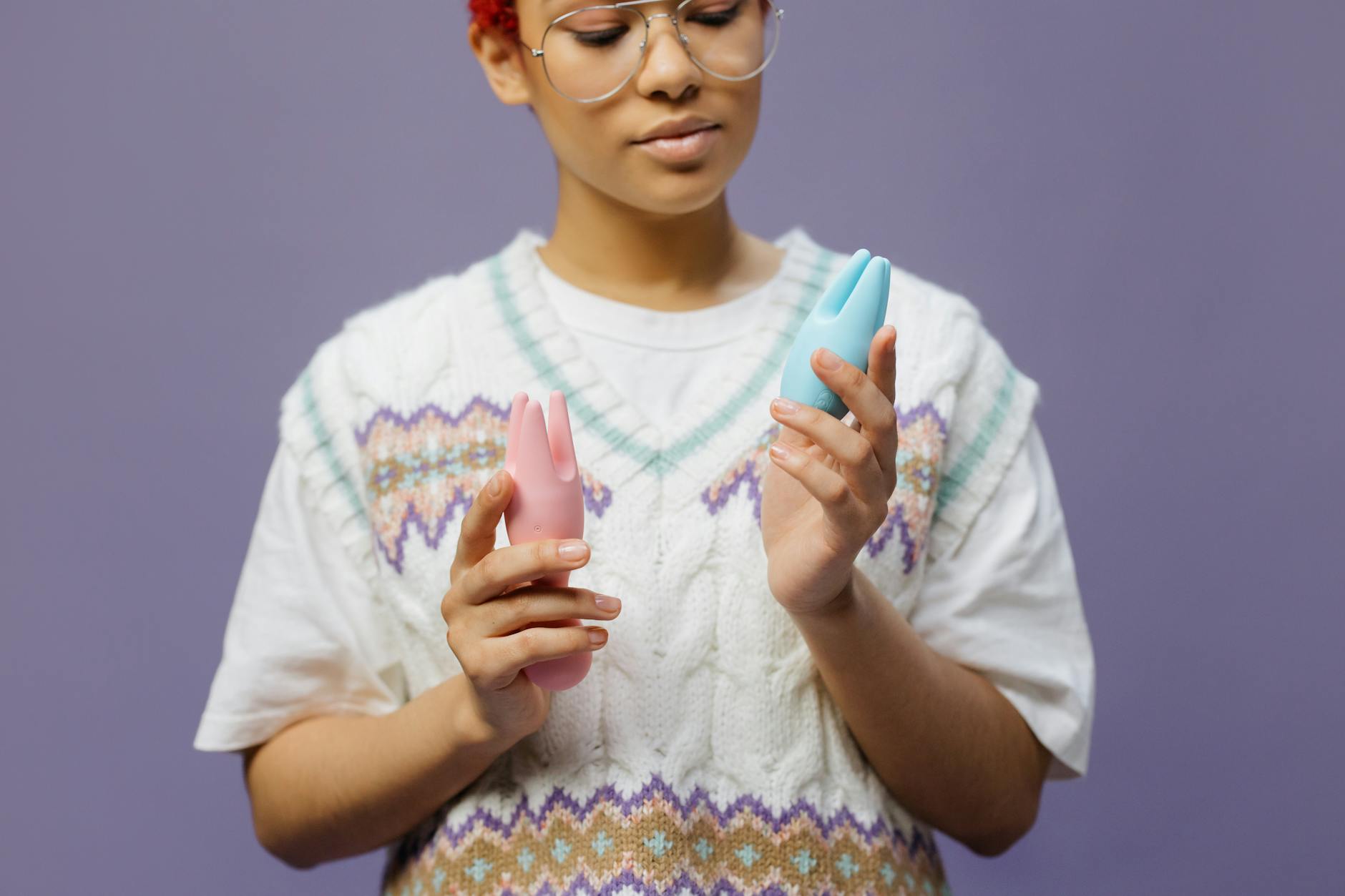
 Photo by cottonbro studio on Pexels